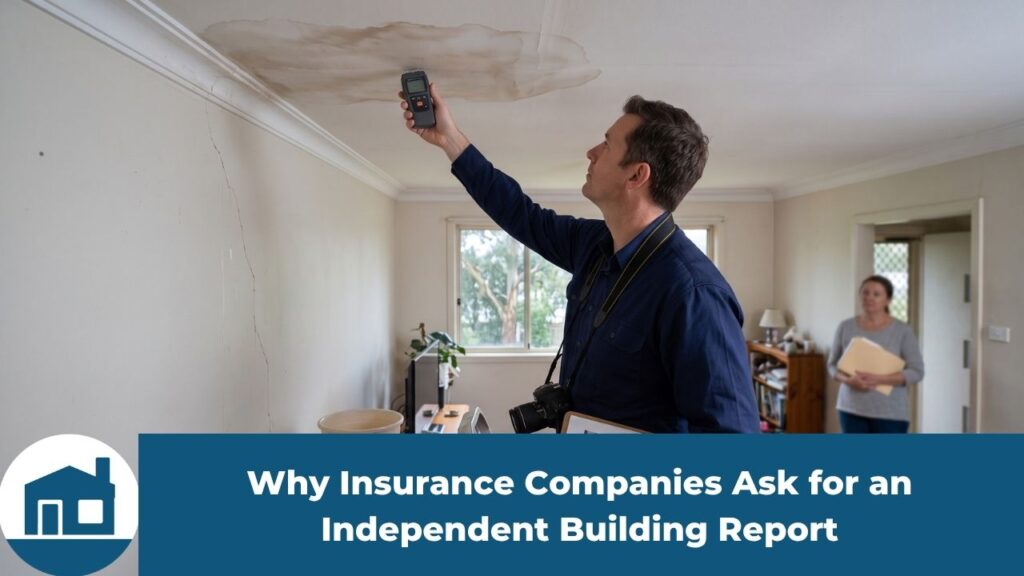
Insurers ask for an independent building report because a claim decision has to rest on evidence, and the industry’s own rules set standards for what that evidence looks like and how quickly it has to arrive. The General Insurance Code of Practice gives your insurer 10 business days to decide once it has everything it needs, four months overall, and 12 weeks for any external expert it engages to report back.
The Code also gives you something most homeowners never use. If your insurer relied on an expert report to make its decision, you could ask for a copy, and they have 10 business days to hand it over. Knowing both halves of that arrangement changes how a claim goes, particularly through storm season.
How long does an insurance claim take?
Under the General Insurance Code of Practice, an insurer must decide a claim within four months of receiving it, or within 10 business days once it has all relevant information and has finished its enquiries. The four months extends to 12 months only where one of the Code’s limited exceptions applies, such as a declared catastrophe, suspected fraud, or a case where you haven’t responded to reasonable requests for information.
| Stage | Code timeframe |
|---|---|
| Insurer tells you what information it needs | 10 business days from receiving the claim |
| You’re notified a loss assessor or investigator has been appointed | 5 business days from appointment |
| External expert’s report completed | 12 weeks from the expert being engaged |
| Progress updates while the claim is open | At least every 20 business days |
| Response to a routine enquiry about your claim | 10 business days |
| Decision once the insurer has everything | 10 business days |
| Decision overall | 4 months, or 12 months where a Code exception applies |
Those numbers are worth writing down. Most claims that go wrong don’t get formally declined, they go quiet, and the timeframes are the thing that lets you name the problem rather than just feeling it.
Can you ask for the insurer’s expert report?
Yes. The Code gives you the right to request copies of any service supplier or external expert reports your insurer relied on when assessing your claim, and it must provide them within 10 business days of your request. If your claim is denied, it also must give you written reasons and tell you how to complain.
This matters more than it sounds. If an assessor has written that cracking at your place is longstanding ground movement rather than storm damage, that conclusion is sitting in a document you’re entitled to read. You can’t respond to reasoning you’ve never seen, and most people never ask for it.
Why independence is what’s being tested
An expert report is only useful to an insurer if the person who wrote it has no stake in the answer. A builder who stands to win the repair contract has an interest in the scope. A tradesperson quoting the job has an interest in its size. Neither is disqualified from being right, but both are easy for a claims manager, or an ombudsman, to discount.
That’s the whole reason a separate report exists. The inspector writes what’s there, states the standards the assessment was measured against, and names their licence and qualifications. We’ve covered what goes inside one of these reports separately. This piece is about the process around it.
What happens when two reports disagree?
You complain, in writing, and the clock starts. For a standard complaint, ASIC’s Regulatory Guide 271 requires a written response within 30 calendar days. Worth knowing: the current Code still prints 45 days at paragraph 147, and that figure predates the ASIC guidance, so 30 calendar days is the operative maximum.
If the insurer can’t meet it, it has to tell you why and tell you that you can escalate. After that, or if the deadline passes, the complaint can go to the Australian Financial Complaints Authority.
| Step | What it is | Timing |
|---|---|---|
| Internal dispute resolution | A formal written complaint to the insurer | Written response within 30 calendar days |
| AFCA | Free external dispute resolution for consumers | Within 2 years of the insurer’s final response |
AFCA is free for consumers, and its determinations bind the insurer if you accept them, though they don’t bind you. Monetary limits apply and they’re updated periodically, so check the current figures rather than relying on a number you read somewhere. At this stage, the quality of your evidence is doing all the work. A report with photographs, moisture readings, a stated methodology and a named licensed author is a different document to a builder’s quote.
What’s changing in the new Code
The 2020 Code, last revised in October 2023, is still the one in force. A fully redrafted Code went to public consultation between June and July 2026 and the Insurance Council has pushed lodgement with ASIC to late October 2026, the second time that date has moved. A transition period of around 24 months is anticipated after approval, so the practical start is some way off.
Two proposed changes matter for anyone making a property claim. Home and motor claims left undecided after 12 months would be automatically accepted, subject to defined exceptions. And insurers and external experts would have to comply with the Insurance Council’s Expert Report Best Practice Standard, raising the bar on what an acceptable expert report looks like.
This is a moving target. Check the current position before relying on any of it, because the timetable has already slipped twice.
What does this mean for a claim around the lake?
Storm season runs from roughly November through to March, and East Coast Lows are what generate the bulk of property claims across Cardiff, Warners Bay, Swansea and the foreshore suburbs. Claims lodged in a cluster after a declared catastrophe are exactly the ones where that 12-month provision applies, which means slower decisions and more reliance on documentation.
Two things help. Photograph and document damage before anything gets cleaned up or made safe, because once a tarp goes on a roof the evidence of how water got in becomes an argument rather than a fact. And a maintenance or condition report taken before an event gives you a dated baseline, which is the single most effective answer to a wear-and-tear argument after one.
Getting a report organised
We’re licensed builders registered with NSW Fair Trading, and we write insurance damage reports across Lake Macquarie, Newcastle, the Hunter Valley, Port Stephens, Maitland and the Central Coast. If your insurer has asked for an independent report, or you’ve been sent an assessment you don’t agree with, get in touch and we’ll tell you honestly whether a report will help.
Frequently asked questions
How long does an insurer have to decide my claim?
Four months from receiving the claim in ordinary circumstances, or 12 months where a Code exception applies, such as a declared catastrophe. Once the insurer has all relevant information and has completed its enquiries, they have 10 business days to tell you the decision.
Can I get a copy of the report my insurer used to decide my claim?
Yes. Under the General Insurance Code of Practice, you can request copies of external expert or service supplier reports the insurer relied on, and it must provide them within 10 business days. If the claim was denied you’re also entitled to written reasons.
Who pays for an independent building report?
Generally, you do, as the policyholder commissioning it. Some policies include a provision for expert reports, and some insurers will contribute where a dispute is resolved in your favour, so read your product disclosure statement and ask the question before you commission anything.
What if my insurer misses the Code timeframes?
Raise it as a formal complaint in writing. That triggers the internal dispute resolution process and a written response within 30 calendar days. If that doesn’t resolve it, you can take the complaint to AFCA, which is free for consumers.
Is a repair quote the same as an independent report?
No. A quote prices work that a builder wants to carry out. An independent report records what’s damaged, how severe it is and what most likely caused it, written by someone with no interest in the repair. Insurers and AFCA treat the two differently.
This article is general information about the general insurance claims process in Australia. It isn’t legal or financial advice, and it isn’t advice about any particular policy or claim. Policy terms vary, and the rules described here were current at the date of publication. For advice on your own claim, speak with your insurer, a solicitor, or a free financial counselling or insurance law service.