
Thermal imaging is included as standard in every pest and building inspection Lake Macquarie Building Inspections carries out across the Hunter Valley. The region’s combination of older housing stock in the established townships, rural and semi-rural properties with multiple structures and a warm inland climate that supports year-round termite activity makes the ability to look inside building elements without opening them an important part of a thorough property inspection.
Stuart and the team use professional-grade thermal imaging cameras on every Hunter Valley inspection. Our inspectors have over 30 years of building industry experience and understand how to interpret thermal findings in the context of the specific building types and conditions common across the valley.
A thermal imaging camera measures the infrared radiation emitted by surfaces and displays it as a colour-coded image showing temperature variations. Because materials and conditions within a building emit heat at different rates depending on their composition and the presence of moisture, pest activity or insulation gaps, a trained inspector can read these thermal images to identify anomalies that would otherwise be invisible on the surface.
Thermal imaging is non-invasive. Our inspectors assess the building without drilling, opening surfaces or causing any disruption to the property. The camera provides access to information about what is happening inside wall cavities, under floors and above ceilings without any physical intrusion.
The Hunter Valley’s warm climate maintains termite activity for much of the year, and the region’s older housing stock in the coalfields towns and the established residential areas of Cessnock, Kurri Kurri and Singleton includes many homes with original linings and construction methods that provide limited visual access to structural elements. Thermal imaging allows our inspectors to identify termite activity in wall cavities and under floors in these properties without the need to open surfaces.
The valley’s temperature range, with cold winters and hot summers, drives condensation in properties that are not adequately insulated. Thermal imaging identifies insulation gaps and deficiencies in walls and ceilings that are contributing to moisture accumulation and energy performance issues that would not be apparent through visual inspection.
Rural properties in the Hunter Valley present additional thermal imaging opportunities. Older rural structures often have a history of modification and repair using varying materials and methods. Thermal imaging allows our inspectors to assess the condition of these structures more thoroughly than visual inspection alone allows.
During a Hunter Valley inspection, thermal imaging assists with identifying:
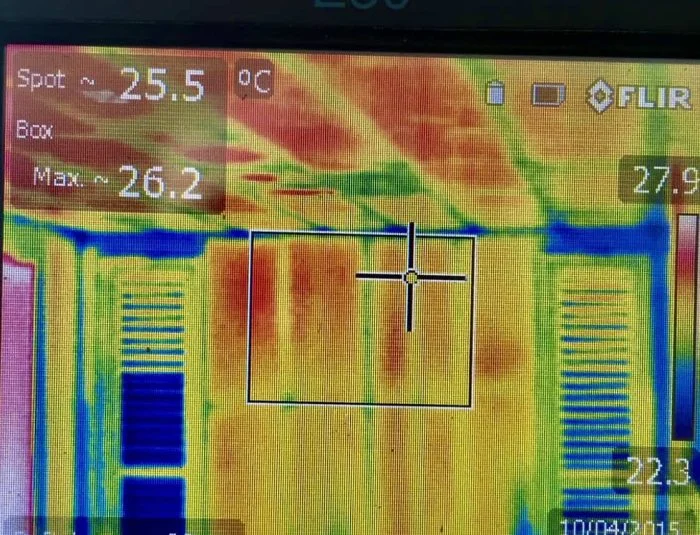
For residential properties in the Hunter Valley townships, thermal imaging assists with identifying termite activity in wall cavities, moisture behind linings from roof or plumbing leaks, insulation deficiencies in walls and ceiling spaces and electrical hot spots in the building’s services.
For rural properties with multiple structures, thermal imaging allows our inspectors to assess timber condition in outbuildings, sheds and rural structures for moisture-related deterioration and pest activity in areas where physical access for detailed visual inspection is limited. It is a particularly effective tool for assessing the condition of older rural buildings that have not been regularly inspected.
We provide a full range of pest and building inspection services across the Hunter Valley:
We carry out thermal imaging inspections across the Hunter Valley region, including:
Cessnock | Kurri Kurri | Aberdare | Singleton | Muswellbrook | Branxton | Pokolbin | Broke | North Rothbury | Heddon Greta | Wollombi | Ellalong | Paxton | Kearsley | and all surrounding towns and localities throughout the Hunter Valley region